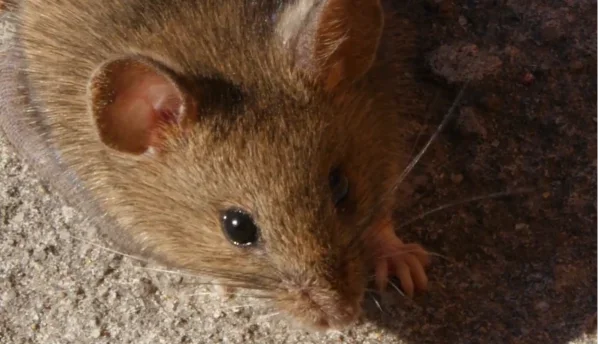
Something is moving in the walls or attic. Before you buy traps, it helps to know what animal you are dealing with, because mice, rats, and squirrels need different trapping, different sealing, and different follow-up. This guide covers the three signs that separate them: droppings, noise timing, and nesting and gnaw marks.
Short answer: Mice leave small, rice-grain droppings and light scratching at night. Rats leave larger droppings, stronger rub marks, and burrow or foundation signs. Squirrels are louder, active in daylight, and often heard scampering or rolling nuts in the attic.
What do mouse droppings look like?
Mouse droppings are small, dark, and shaped like grains of rice, often found along baseboards, in drawers, and behind appliances.
Fresh droppings are dark and soft; older ones turn gray and crumbly. Mice leave droppings as they travel, so trails along baseboards, inside pantry corners, and behind the stove are typical. Droppings in more than one room point to a population rather than a single mouse. Do not sweep or vacuum droppings dry. The safe droppings cleanup guide covers the CDC steps. If droppings appear in kitchens, pantries, and wall voids together, the fix is on the mice removal page: inspection, trapping, sealing, cleanup, and monitoring.
What do rat droppings look like?
Rat droppings are larger than mouse droppings, blunt-ended, and often found near foundations, basements, and along runs.
Norway rats use basements, foundations, burrows, and ground-level voids. Roof rats use higher voids, attics, and rooflines. Rats also leave grease rub marks where their bodies brush walls and floorboards, gnaw marks on wood and wire insulation, and tracks or runways in dust. Burrow openings near a foundation, larger droppings, and a stronger smell point toward rats rather than mice. The rat removal page explains the trapping and sealing sequence for Norway and roof rats.
How do I tell squirrels apart from mice and rats?
Squirrels are active in daylight, louder, and heavier on their feet. Mice and rats are mostly active at night.
Squirrel noise in an attic often sounds like scampering, thumping, or rolling, and it happens in the morning and late afternoon. Mouse and rat noise is lighter scratching and scurrying, usually at night. Squirrels also leave larger droppings, nut shells, and nesting material near roofline gaps, and they enter through soffit, eave, and roofline openings. Squirrels need different handling than mice and rats, including different rules around removal and release. Ask whether squirrel work is offered before booking, and do not seal a roofline gap while squirrels may still be inside.
What do the noises mean?
Light scratching at night usually means mice or rats in a wall void. Louder daytime scampering in an attic usually means squirrels.
Night scratching in a kitchen wall often traces to mice traveling along pipes. Night scratching in a basement ceiling can be rats in a void below the floor. Daytime noise in an attic, especially near dawn and dusk, is the classic squirrel pattern. Noise alone never identifies the animal with certainty. Droppings, gnaw marks, rub marks, and entry points together give the answer, and an inspection with photos settles it.
Why does identification change the fix?
Mice need many small gaps sealed. Rats need burrow and foundation work. Squirrels need roofline work and different handling.
Mice fit through gaps of about a quarter inch, roughly the size of a dime, so sealing must cover pipes, vents, door sweeps, and small foundation cracks. Rats use gaps of about half an inch and need foundation, sill, and burrow attention. Squirrels enter at the roofline and need that area checked. Trapping also differs: placement, trap type, and checking schedule depend on the animal. The exclusion page explains how sealing follows identification and removal.
How an inspection confirms it
Your notes narrow the answer, but an inspection settles it. The inspector checks droppings size and freshness, gnaw and rub marks, nesting material, and entry points, then matches them to the animal. Photos document each finding, so the trapping and sealing plan fits the animal actually present rather than a guess. If two animals share the structure, the plan covers both, starting with the one causing the most damage.
What to do next
Note the droppings size, the noise timing, and the rooms where you hear it. Take a photo of droppings and entry points if you can do so safely. Then request a callback for identification, photos, and a quote before work begins. Do not seal gaps before the inspection if animals may still be inside.
Sources: U.S. Centers for Disease Control and Prevention (CDC) rodent guidance; U.S. Environmental Protection Agency (EPA) guidance on identifying and preventing rodent infestations. Health information here is general information, not medical advice.